

Forex Trading Strategies Price Action

1- The definition Of Cost Activity trading
2- Trading with "Messy" Vs "Clean" Charts
3- How to identify trending and consolidating markets using price action
iv- How to trade with Cost Action trading strategies
5- How to use nautical chart confluence and Price Action signals
The Definition of Toll Action Trading
Price Action Trading (P.A.T.) is the discipline of making all of your trading decisions from a stripped downwardly or "naked" cost chart. This means no lagging indicators outside of maybe a couple moving averages to help identify dynamic back up and resistance areas and trend. All financial markets generate data about the movement of the price of a market place over varying periods of time; this data is displayed on cost charts. Price charts reverberate the beliefs and actions of all participants (human or reckoner) trading a market during a specified menses of time and these behavior are portrayed on a market'due south cost chart in the class of "price action" (P.A.).
Whilst economical information and other global news events are the catalysts for price movement in a market, nosotros don't need to clarify them to merchandise the market successfully. The reason is pretty simple; all economic information and globe news that causes toll movement inside a market place is ultimately reflected via P.A. on a market's price chart.
Since a market place's P.A. reflects all variables affecting that market place for any given period of fourth dimension, using lagging toll indictors like stochastics, MACD, RSI, and others is just a apartment waste of time. Price move provides all the signals you will e'er need to develop a profitable and high-probability trading system. These signals collectively are chosen price action trading strategies and they provide a way to make sense of a market's price movement and aid predict its hereafter motion with a high enough degree of accuracy to give you a high-probability trading strategy.
"Clean" Charts vs. "Messy" Indicator-laden Charts
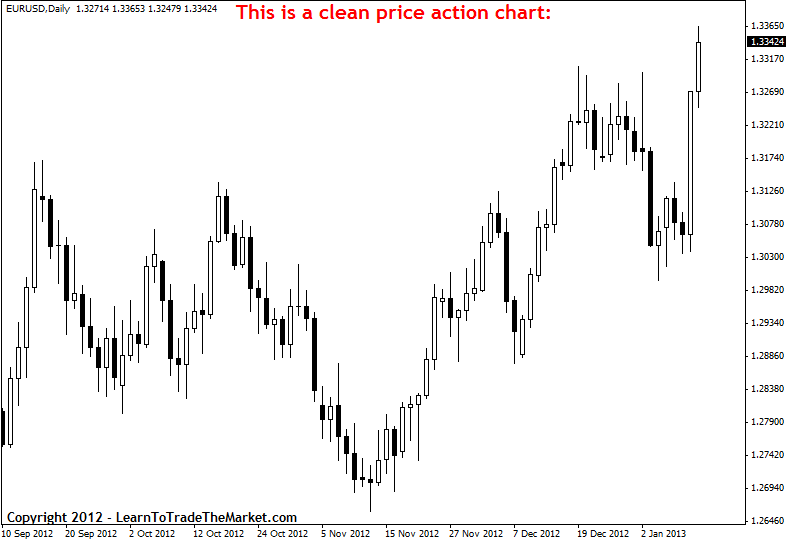
Next, to demonstrate the stark dissimilarity between a pure P.A. chart and one with some of the well-nigh popular trading indicators on it, I have shown 2 charts in the examples beneath. The chart on the top has no indicators on it, at that place's null just the raw P.A. of the market place on that chart. The lesser chart has MACD, Stochastics, ADX and Bollinger Bands on information technology; iv of the most widely used indicators AKA "secondary" analysis tools as they are sometimes called:
The image example beneath shows a make clean cost action nautical chart, with no mess, and no indicators, just pure price confined:
The image case below shows a messy price activeness chart, with lots of clutter, indicators and mess:
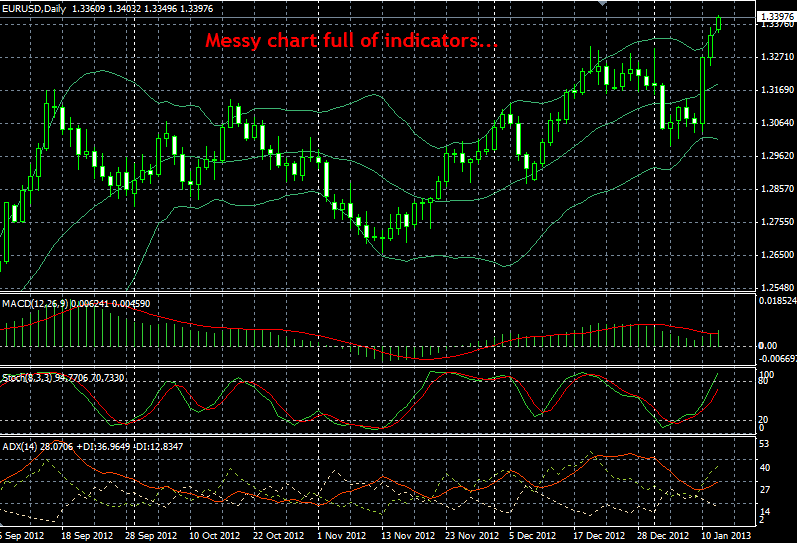
It'due south worth pointing out how in the indicator-laden chart you lot really have to give up some room on the chart to take the indicators at the bottom, this forces you lot to brand the P.A. part of the chart smaller, and it also draws your attention away from the natural P.A. and onto the indicators. Then, not simply do you have less screen expanse to view the P.A., simply your focus is not totally on the price action of the market like information technology should exist.
If you really await at both of those charts and think about which one is easier to analyze and trade from, the answer should be pretty clear. All of the indicators on the chart below, and indeed almost all indicators, are derived from the underlying P.A.. In other words, all traders do when they add indicators to their charts is produce more variables for themselves; they aren't gaining any insight or predictive clues that aren't already provided past the market place's raw price activity.
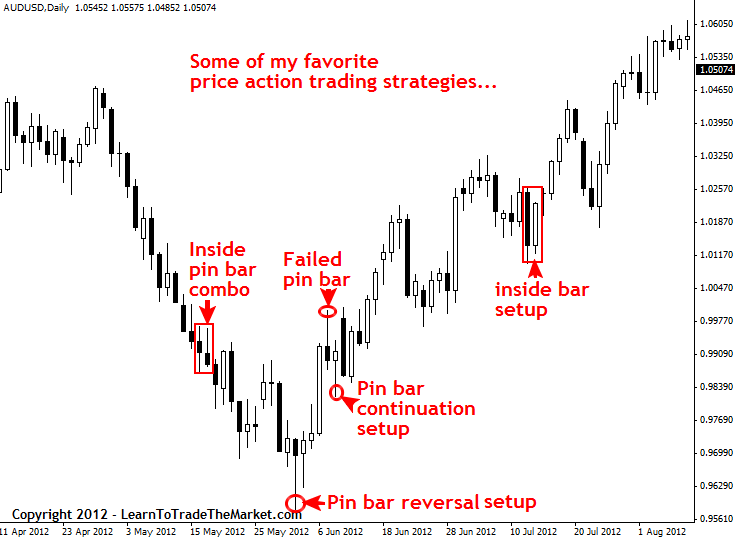
Examples of some of my favorite cost activeness trading strategies:
Next, let's take a look at some of the cost activeness trading strategies that I teach. Note that I've included a "failed" trade setup because not every trade will exist a winner; we aren't here to show y'all "perfect" past trading results…nosotros are here to teach you lot in an honest and realistic manner.
In the paradigm example below, nosotros are looking some of my favorite P.A. trading strategies:
Decide a market's tendency using toll action
One of the nigh important aspects of learning to merchandise with P.A. is to first learn how to identify a trending market versus a consolidating market. Trading with the trend is highest-probability way to trade and it'due south something y'all Accept TO learn how to exercise if y'all desire to stand up a chance at making serious money as a trader.
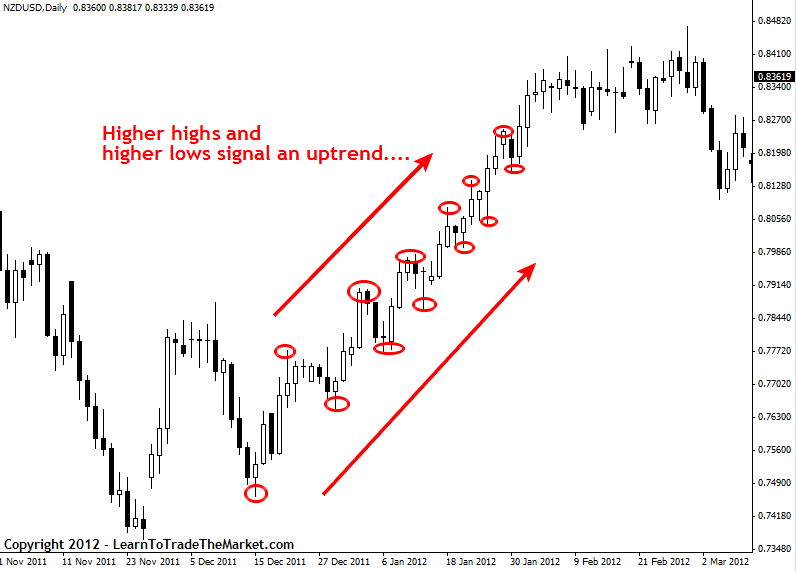
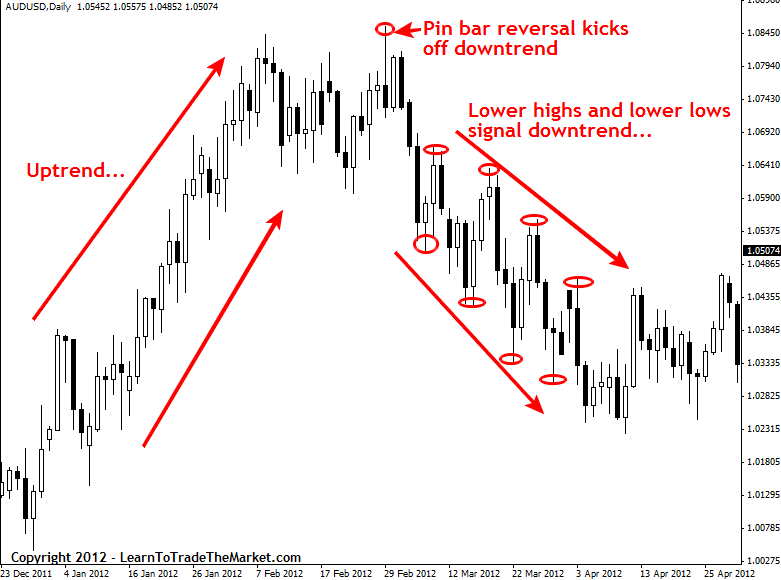
The charts below shows how to employ price dynamics to determine a markets trend. Nosotros consider a market place to be in an uptrend if it is making Higher Highs and Higher Lows (HH, HL) and a downtrend is Lower Highs and Lower Lows (LH, LL).
In the image example beneath, we can see how higher highs and higher lows indicate an up-trend in a market:
In the image example below, we can come across how lower highs and lower lows indicate a down-trend in a marketplace:
Decide Trending VS. Consolidating markets using toll activeness
As we discussed earlier, P.A.or "price activity trading analysis" is the analysis of the toll movement of a market place over time. From our analysis of price movement nosotros can determine a market'south underlying directional bias or "tendency", or if the market has no trend it is said to exist "consolidating"…we can easily make up one's mind whether a market is trending or consolidating from merely analyzing its P.A.. We saw how to decide a market's trend to a higher place, to decide if a market is consolidating we just await for an absence of the HH, HL or LH, LL patterns. In the chart beneath note how the "consolidating price action" is bouncing betwixt a horizontal support and resistance level and is non making HH, HL or LH, LL just is instead going sideways…
The image case below shows a market moving from a consolidation phase to a trending stage:

How to Trade with Cost Action Trading Strategies
So how exactly do nosotros merchandise with toll activity? Information technology really boils downward to learning to trade P.A. setups or patterns from confluent levels in the market. At present, if that sounds new or confusing to you right now, sit tight and I will clarify it soon. Showtime nosotros demand to embrace a couple more than things:
Due to the repetitive nature of market participants and the mode they react to global economic variables, the P.A. of a market tends to echo itself in various patterns. These patterns are too called price activity trading strategies, and in that location are many different toll action strategies traded many different ways. These reoccurring toll patterns or toll action setups reflect changes or continuation in market sentiment. In layman'due south terms, that just ways by learning to spot toll action patterns you can become "clues" equally to where the price of a market place will become next.
The first matter you lot should to begin P.A. trading is to take off all the "crap" on your charts. Get rid of the indicators, expert advisors; take off EVERYTHING merely the raw price bars of the nautical chart. I prefer to use candlestick charts because I experience they convey the price data of the market more dynamically and "forcefully", if you are however using classic bar charts and want more info on candlesticks then checkout this candlestick trading tutorial.
I like simple blackness and white charts the all-time, as you can see below. In metatrader4 you simply right click on the chart and suit the "backdrop" of the nautical chart to get information technology looking like mine below. If you want more info on how to setup your MT4 trading platform checkout this metatrader four tutorial.
Subsequently you've removed all the indicators and other unnecessary variables from your charts, you can brainstorm drawing in the cardinal chart levels and looking for price action setups to trade from.
The image instance beneath shows examples of some of the trading strategies I teach in my toll activeness trading course. Note the key back up / resistance levels have been drawn in:

How to trade price activity from confluent points in the market:
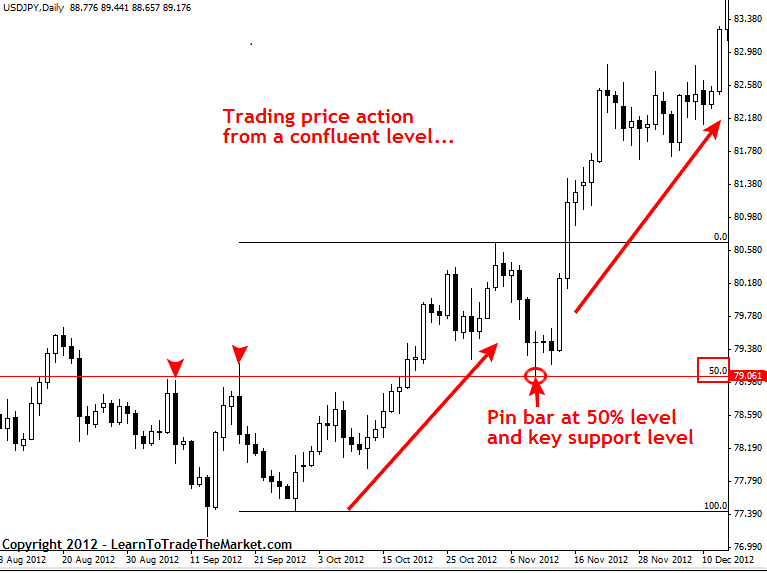
The next major step in trading P.A. is to draw in the key nautical chart levels and look for confluent levels to merchandise from. In the nautical chart below we can see that a very obvious and confluent pin bar setup formed in the USDJPY that kicked off a huge uptrend higher. Notation that the pivot bar merchandise setup showed rejection of a fundamental horizontal support level every bit well equally the 50% retrace of the last major motion, thus the pin bar had "confluence" with the surrounding market place structure…
In the image example below, nosotros tin can see a pin bar setup that formed at a confluent point in the market:
All economic variables create toll movement which can exist easily seen on a market's cost chart. Whether an economic variable is filtered down through a homo trader or a estimator trader, the motility that it creates in the market will be easily visible on a price nautical chart. Therefore, instead of trying to analyze a million economic variables each day (this is incommunicable obviously, although many traders endeavor), you can simply larn to merchandise price action, because this style of trading allows you to easily analyze and make use of all market variables by simply reading and trading from the P.A. trail they leave behind in a market place.
Closing thoughts on Cost Action Trading…
I hope today'south introduction to Cost Action Trading has been a helpful and enlightening lesson for you. No matter what strategy or system y'all end upwards trading with, having a solid understanding of P.A. will only make y'all a better trader. If yous're like me, and you love simplicity and minimalism, you'll want to become a "pure" P.A trader and remove all unnecessary variables from your charts. If you're interested in learning how I trade with simple price activeness strategies, checkout my Price Action Trading Form for more info.
Good trading, Nial Fuller
Related Cost Action Lessons:
- Price Activity Signals Introduction
- Price Activity Strategies Introduction
- Professional person Toll Action Strategies – Introduction
- What Is Price Action Assay ?
- Cost Activity – The Footprint Of Money
- How to Filter Skillful & Bad Price Action Trading Signals


Nial Fuller
About Nial Fuller
is a Professional person Trader, Investor & Author who is considered 'The Authority' on Price Activity Trading. His web log is read by over 200,000+ followers and he has taught 25,000+ students since 2008. In 2016, Nial won the Million Dollar Trader Competition. Checkout Nial'due south Professional Trading Course here.

Source: https://www.learntotradethemarket.com/price-action-trading-forex
Posted by: worleyounded.blogspot.com
0 Response to "Forex Trading Strategies Price Action"
Post a Comment