

how long has binary code options been around

The word 'Wikipedia' represented in ASCII binary code, fabricated upward of 9 bytes (72 bits).
A binary code represents text, computer processor instructions, or any other information using a ii-symbol system. The two-symbol system used is ofttimes "0" and "i" from the binary number arrangement. The binary lawmaking assigns a blueprint of binary digits, likewise known equally bits, to each character, instruction, etc. For example, a binary string of viii bits can represent whatsoever of 256 possible values and can, therefore, correspond a wide diverseness of unlike items.
In calculating and telecommunications, binary codes are used for various methods of encoding data, such as grapheme strings, into bit strings. Those methods may use stock-still-width or variable-width strings. In a fixed-width binary code, each letter, digit, or other character is represented by a bit cord of the same length; that scrap cord, interpreted as a binary number, is ordinarily displayed in code tables in octal, decimal or hexadecimal notation. There are many character sets and many grapheme encodings for them.
A bit string, interpreted as a binary number, tin can be translated into a decimal number. For case, the lower case a, if represented by the bit cord 01100001 (equally information technology is in the standard ASCII code), tin also be represented equally the decimal number "97".
History of binary codes [edit]
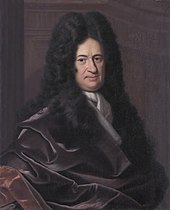
The modern binary number system, the basis for binary code, was invented by Gottfried Leibniz in 1689 and appears in his article Explication de l'Arithmétique Binaire. The full title is translated into English equally the "Explanation of the binary arithmetic", which uses only the characters 1 and 0, with some remarks on its usefulness, and on the low-cal it throws on the aboriginal Chinese figures of Fu Eleven.[1] Leibniz's system uses 0 and one, similar the modern binary numeral system. Leibniz encountered the I Ching through French Jesuit Joachim Bouvet and noted with fascination how its hexagrams stand for to the binary numbers from 0 to 111111, and concluded that this mapping was prove of major Chinese accomplishments in the sort of philosophical visual binary mathematics he admired.[2] [iii] Leibniz saw the hexagrams as an affirmation of the universality of his own religious belief.[3]
Binary numerals were central to Leibniz'due south theology. He believed that binary numbers were symbolic of the Christian idea of creatio ex nihilo or creation out of nothing.[iv] Leibniz was trying to find a organization that converts logic verbal statements into a pure mathematical one[ citation needed ]. After his ideas were ignored, he came across a classic Chinese text called I Ching or 'Book of Changes', which used 64 hexagrams of 6-bit visual binary lawmaking. The volume had confirmed his theory that life could be simplified or reduced down to a series of straightforward propositions. He created a organisation consisting of rows of zeros and ones. During this fourth dimension period, Leibniz had not yet found a use for this system.[5]
Binary systems predating Leibniz also existed in the aboriginal world. The aforementioned I Ching that Leibniz encountered dates from the 9th century BC in Communist china.[6] The binary arrangement of the I Ching, a text for divination, is based on the duality of yin and yang.[7] Slit drums with binary tones are used to encode messages across Africa and Asia.[7] The Indian scholar Pingala (around 5th–2nd centuries BC) developed a binary arrangement for describing prosody in his Chandashutram.[8] [9]

The residents of the isle of Mangareva in French Polynesia were using a hybrid binary-decimal system before 1450.[10] In the 11th century, scholar and philosopher Shao Yong developed a method for arranging the hexagrams which corresponds, albeit unintentionally, to the sequence 0 to 63, every bit represented in binary, with yin as 0, yang every bit ane and the least significant fleck on top. The ordering is also the lexicographical order on sextuples of elements chosen from a ii-element set up.[eleven]
In 1605 Francis Bacon discussed a organisation whereby letters of the alphabet could be reduced to sequences of binary digits, which could then be encoded as scarcely visible variations in the font in any random text.[12] Importantly for the general theory of binary encoding, he added that this method could be used with whatever objects at all: "provided those objects exist capable of a twofold difference only; as by Bells, by Trumpets, past Lights and Torches, by the study of Muskets, and any instruments of similar nature".[12]
George Boole published a newspaper in 1847 called 'The Mathematical Analysis of Logic' that describes an algebraic organization of logic, now known as Boolean algebra. Boole'due south system was based on binary, a yes-no, on-off approach that consisted of the three near basic operations: AND, OR, and NOT.[13] This system was non put into use until a graduate student from Massachusetts Constitute of Technology, Claude Shannon, noticed that the Boolean algebra he learned was like to an electric circuit. Shannon wrote his thesis in 1937, which implemented his findings. Shannon's thesis became a starting point for the use of the binary code in practical applications such as computers, electric circuits, and more.[14]
Other forms of binary lawmaking [edit]
The bit cord is not the only blazon of binary code: in fact, a binary system in full general, is any arrangement that allows only two choices such every bit a switch in an electronic system or a simple truthful or false test.
Braille [edit]
Braille is a type of binary code that is widely used by the blind to read and write by bear upon, named for its creator, Louis Braille. This system consists of grids of six dots each, iii per cavalcade, in which each dot has two states: raised or not raised. The different combinations of raised and flattened dots are capable of representing all letters, numbers, and punctuation signs.
Bagua [edit]
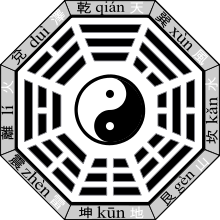
The bagua are diagrams used in feng shui, Taoist cosmology and I Ching studies. The ba gua consists of 8 trigrams; bā significant 8 and guà meaning divination effigy. The aforementioned word is used for the 64 guà (hexagrams). Each figure combines three lines (yáo) that are either cleaved (yin) or unbroken (yang). The relationships betwixt the trigrams are represented in ii arrangements, the primordial, "Earlier Heaven" or "Fuxi" bagua, and the manifested, "Afterward Heaven,"or "King Wen" bagua. [fifteen] (See also, the King Wen sequence of the 64 hexagrams).
Ifá, Ilm Al-Raml and Geomancy [edit]
The Ifá/Ifé arrangement of divination in African religions, such as of Yoruba, Igbo, Ewe, consists of an elaborate traditional anniversary producing 256 oracles made up by 16 symbols with 256 = 16 x 16. An initiated priest "babalowo" who had memorized oracles, would request sacrifice from consulting clients and make prayers. Then, divination basics or a pair of bondage are used to produce random binary numbers, which are fatigued with sandy material on an "Opun" figured wooden tray representing the totality of fate.
Through the spread of Islamic culture, Ifé/Ifá was assimilated every bit the "Science of Sand" (ilm al-raml), which then spread further and became "Science of Reading the Signs on the Footing" (Geomancy) in Europe.
This was idea to be another possible route from which informatics was inspired,[xvi] every bit Geomancy arrived at Europe at an earlier stage (about 12th Century, described by Hugh of Santalla) than I Ching (17th Century, described by Gottfried Wilhelm Leibniz).
Coding systems [edit]
ASCII lawmaking [edit]
The American Standard Code for Data Interchange (ASCII), uses a seven-bit binary code to represent text and other characters within computers, communications equipment, and other devices. Each letter or symbol is assigned a number from 0 to 127. For example, lowercase "a" is represented past 1100001 as a bit string (which is "97" in decimal).
Binary-coded decimal [edit]
Binary-coded decimal (BCD) is a binary encoded representation of integer values that uses a 4-bit crumb to encode decimal digits. 4 binary bits tin encode up to 16 distinct values; but, in BCD-encoded numbers, only ten values in each nibble are legal, and encode the decimal digits zilch, through nine. The remaining half-dozen values are illegal and may cause either a machine exception or unspecified behavior, depending on the computer implementation of BCD arithmetic.
BCD arithmetic is sometimes preferred to floating-point numeric formats in commercial and fiscal applications where the circuitous rounding behaviors of floating-point numbers is inappropriate.[17]
Early uses of binary codes [edit]
- 1875: Émile Baudot "Addition of binary strings in his ciphering system," which, somewhen, led to the ASCII of today.
- 1884: The Linotype motorcar where the matrices are sorted to their corresponding channels later on use past a binary-coded slide track.
- 1932: C. E. Wynn-Williams "Scale of Two" counter[xviii]
- 1937: Alan Turing electro-mechanical binary multiplier
- 1937: George Stibitz "excess 3" code in the Complex Computer[18]
- 1937: Atanasoff–Berry Computer[18]
- 1938: Konrad Zuse Z1
Current uses of binary [edit]
Nigh mod computers use binary encoding for instructions and data. CDs, DVDs, and Blu-ray Discs represent sound and video digitally in binary grade. Phone calls are carried digitally on long-distance and mobile phone networks using pulse-code modulation, and on voice over IP networks.
Weight of binary codes [edit]
The weight of a binary lawmaking, as defined in the table of constant-weight codes,[19] is the Hamming weight of the binary words coding for the represented words or sequences.
Meet as well [edit]
- Binary number
- List of binary codes
- Binary file
- Unicode
- Gray lawmaking
References [edit]
- ^ Leibniz G., Explication de l'Arithmétique Binaire, Die Mathematische Schriften, ed. C. Gerhardt, Berlin 1879, vol.7, p.223; Engl. transl.[1]
- ^ Aiton, Eric J. (1985). Leibniz: A Biography. Taylor & Francis. pp. 245–8. ISBN978-0-85274-470-3.
- ^ a b J.E.H. Smith (2008). Leibniz: What Kind of Rationalist?: What Kind of Rationalist?. Springer. p. 415. ISBN978-i-4020-8668-7.
- ^ Yuen-Ting Lai (1998). Leibniz, Mysticism and Religion. Springer. pp. 149–150. ISBN978-0-7923-5223-5.
- ^ "Gottfried Wilhelm Leibniz (1646 - 1716)". www.kerryr.net.
- ^ Edward Hacker; Steve Moore; Lorraine Patsco (2002). I Ching: An Annotated Bibliography. Routledge. p. 13. ISBN978-0-415-93969-0.
- ^ a b Jonathan Shectman (2003). Groundbreaking Scientific Experiments, Inventions, and Discoveries of the 18th Century. Greenwood Publishing. p. 29. ISBN978-0-313-32015-half dozen.
- ^ Sanchez, Julio; Canton, Maria P. (2007). Microcontroller programming: the microchip PIC. Boca Raton, Florida: CRC Press. p. 37. ISBN978-0-8493-7189-9.
- ^ W. South. Anglin and J. Lambek, The Heritage of Thales, Springer, 1995, ISBN 0-387-94544-10
- ^ Bender, Andrea; Beller, Sieghard (16 December 2013). "Mangarevan invention of binary steps for easier adding". Proceedings of the National University of Sciences. 111 (4): 1322–1327. doi:x.1073/pnas.1309160110. PMC3910603. PMID 24344278.
- ^ Ryan, James A. (January 1996). "Leibniz' Binary Arrangement and Shao Yong's "Yijing"". Philosophy East and West. 46 (1): 59–90. doi:10.2307/1399337. JSTOR 1399337.
- ^ a b Bacon, Francis (1605). "The Advancement of Learning". London. pp. Chapter i.
- ^ "What's So Logical Nearly Boolean Algebra?". www.kerryr.net.
- ^ "Claude Shannon (1916 - 2001)". www.kerryr.net.
- ^ Wilhelm, Richard (1950). The I Ching or Book of Changes. trans. past Cary F. Baynes, foreword by C. One thousand. Jung, preface to third ed. by Hellmut Wilhelm (1967). Princeton, NJ: Princeton Academy Press. pp. 266, 269. ISBN978-0-691-09750-3.
- ^ Eglash, Ron (June 2007). "The fractals at the centre of African designs". www.ted.com. Archived from the original on 2021-07-27. Retrieved 2021-04-fifteen .
- ^ Cowlishaw, Mike F. (2015) [1981,2008]. "General Decimal Arithmetic". IBM. Retrieved 2016-01-02 .
- ^ a b c Glaser 1971
- ^ Table of Constant Weight Binary Codes
External links [edit]
- Sir Francis Bacon'due south BiLiteral Zip system, predates binary number arrangement.
- Weisstein, Eric W. "Error-Correcting Code". MathWorld.
- Table of general binary codes. An updated version of the tables of bounds for pocket-sized full general binary codes given in M.R. Best; A.Due east. Brouwer; F.J. MacWilliams; A.Grand. Odlyzko; N.J.A. Sloane (1978), "Bounds for Binary Codes of Length Less than 25", IEEE Trans. Inf. Theory, 24: 81–93, CiteSeerXx.ane.i.391.9930, doi:10.1109/tit.1978.1055827 .
- Table of Nonlinear Binary Codes. Maintained by Simon Litsyn, E. M. Rains, and N. J. A. Sloane. Updated until 1999.
- Glaser, Anton (1971). "Chapter VII Applications to Computers". History of Binary and other Nondecimal Numeration. Tomash. ISBN978-0-938228-00-iv. cites some pre-ENIAC milestones.

Source: https://en.wikipedia.org/wiki/Binary_code
Posted by: worleyounded.blogspot.com
0 Response to "how long has binary code options been around"
Post a Comment